Monday, October 15, 2007

"Our revels now are ended..."


Four years ago this noon, I was passed an urgent message at work to call my mother. I dialed her up immediately and found her in tears, sobbing, unable really to talk.

"What is it?" I asked. "What's the matter?"

"It's your father," she got out, and sobbed some more. (They'd been divorced almost thirty years… and still she worried sometimes about his failing health.)

My heart skipped a beat, then resumed at a harder pace. "What is it? Can I call someone else" – (two brothers and two sisters, for instance, are just ten or eleven digits away) – "who can tell me?" I wanted to spare her this struggle.

Mother pulled herself together enough to blurt out, "He's dead."

This couldn't be. My heart gave up its duties for good, and switched over to kicking tremendous loads of ice-water through my system. Before hanging up and dashing out the door, I got a quick summary from my mother, that Dad hadn't shown up that morning to teach his university class, and that the police and one of my brothers had found him, cold already, gone, on the kitchen floor of the house we'd lived much of our childhoods in.

As the icewater in me boiled and flowed down my face while I raced home – about forty miles – the tiny piece of my mind not in utter shock was trying to insulate me by writing a verse, pivoting around the word whole/hole: that now there was a hole that would remain in me forever, where once Dad's great voice boomed; that in too few days a hole in the earth would claim him; that the rest of my days I'd not be whole any longer; and so on. But even over the next few stunned days, I couldn't pull the lines together, and the work remains even less complete than Gilbert Stuart's painting of the father of our country.

What I did manage to compose was a eulogy. With input and suggestions from the family, over the next couple days I wrote a memoriam to this complex man, who had raised, confused, infuriated, inspired, hurt, sustained, baffled, and entertained us all our lives… often all at once.

Then I had the nerve-rattling honor of addressing his church – with a brother and sister beside me to speak as well, and to lend strength (each of us to the others, in fact), at his memorial service – a day before what would have been his seventy-second birthday. Dad ought to've snorted, climbed out of his casket, and sat down in the front row just to witness this spectacle of three of his offspring at the – Lutheran – pulpit. He may well have, in fact, for all I could perceive of what was going on around us.

(I'll put that eulogy here in a moment.)

During this span of shattered days I found songs whirling through my head: Harrison's "All Things Must Pass", Bread's "Everything I Own", Fogelberg's "Leader of the Band", Rutherford's "The Living Years", and so on. Some literary quotes, too, bubbled up. From Shakespeare's "The Tempest" came one passage in particular; I also checked it out in several translations in German (Dad's language of birth and most of his academics), but noted quickly that they couldn’t convey the impact of this:

Our revels now are ended. These our actors,
As I foretold you, were all spirits and

Now a moment, some minutes, of music
Are melted into air, into thin air;
And, like the baseless fabric of this vision,
The cloud-capp'd towers, the gorgeous palaces
The solemn temples, the great globe itself,

Yea, all which it inherit, shall dissolve
And, like this insubstantial pageant faded,
Leave not a rack behind. We are such stuff

As dreams are made on, and our little life
Is rounded with a sleep.

The Tempest, iv. i. 148-58

I'm still planning on printing this up in a Tudor-style font, or Fraktur, colored, laminating it, and leaving it by his stone.

This quote triggered a second one; I found that the greater part of Swinburne's "The Garden of Proserpine" likewise echoed what I (and no doubt many others) were feeling at our loss:

Here, where the world is quiet;
Here, where all trouble seems
Dead winds' and spent waves' riot
In doubtful dreams of dreams;
I watch the green field growing
For reaping folk and sowing,
For harvest-time and mowing,
A sleepy world of streams.

I am tired of tears and laughter,
And men that laugh and weep;
Of what may come hereafter
For men that sow to reap:
I am weary of days and hours,
Blown buds of barren flowers,
Desires and dreams and powers
And everything but sleep.

[…]

There go the loves that wither,
The old loves with wearier wings;

[…]
Wild leaves that winds have taken,
Red strays of ruined springs.

We are not sure of sorrow,
And joy was never sure;
To-day will die to-morrow;
Time stoops to no man's lure;
And love, grown faint and fretful,
With lips but half regretful
Sighs, and with eyes forgetful
Weeps that no loves endure

From too much love of living,
From hope and fear set free,
We thank with brief thanksgiving
Whatever gods may be
That no life lives for ever;

[…]
That even the weariest river
Winds somewhere safe to sea

– Algernon Charles Swinburne

(If you have a hymnal handy, look up "The Church's One Foundation"; this poem can be sung to that tune, if you wedge in an extra beat at each stanza's sixth line.)

While you have your hymnal out, have a go at "A Mighty Fortress Is Our God", which we sang at his memorial, and which he'd requested years earlier – and I think Dad may have shot out of the ground, still spinning like a flywheel, last Sunday (a week ago yesterday) when we sang it at Mass. (Afterward, our priest beamed, and said – I don't know if he meant it ironically, or seriously – "Martin Luther would be proud.") More likely Dad just grinned smugly. We may keep that grin on him through all eternity, too – "Ein Feste Burg" might be added to his stone.

And while we're here in church – and before I segue into my family's eulogy for Dad – I want to add a word for Norman, my (ex-) father-in-law, who passed away just days after my father, and whose funeral was held the same day and at the same time, leaving my older daughter – oldest, favorite, doted-on grandchild on both sides of the family – torn over which to attend; I gently had her attend her maternal grandfather's; her mom (whom I'd divorced almost twenty years earlier) looked so devastated that I knew she'd need the extra shoulder to rest her broken heart on. (Yet even in the midst of her own private anguish over her lost father, Beej – my daughter's mom – somehow found enough presence of mind to offer me her condolences at my own loss.)

No, strike that; I'm going to give Norm his own blog-posting in a few days – he (and my daughter, and her mom) deserve that.

But this afternoon I did swing out to my father-in-law's grave – headed home from Dad's, and Dad's memorial plaque on campus – to thank him (and his late wife, now at his side again) for two beautiful women who've so wonderfully shaped my life: his daughter, whom I married, and the daughter she gave me in turn.

My own dad… I don't know how to thank, and in his own case this would be tacky and not nearly as… appropriate? So for him, here's this:

For Dad: In Memoriam

October 21, 2003

This morning I saw that my DayTimer had a quote that especially describes my father, and I thought I'd start by sharing it with you: "Plunge boldly into the thick of life." It was written by Goethe, one of my father's favorite authors.

Over these last several days since our father's passing, we've found much comfort in the words and recollections graciously and freely offered to us by many of you, his students and colleagues and friends – both here in his church, and on the University campus.

You truly understand the depth of this terrible ache that we, his family of flesh and blood and tender years, are carrying now at this loss, because it so closely mirrors your own. And even in our own grief, we in turn share our condolences with you, who have lost a giant talent of a teacher; a beautiful, Christian soul of a long and proud tradition; and an utterly irreplaceable icon of a good and loving friend.

We do keenly know how many of his years, and how much of his heart and mind and soul, he poured into his work and worship; and so for all of us there is a great deal of peace and consolation in recognizing that these are things he was doing to his very end. There was to be no long decline for him, no period of great weakness, or fading or feebleness, before he was called back home to God. There was no retirement for him, even – something about which he'd only just begun speaking to some of us, in the last few weeks before his death. It is a beautiful tribute to his love and dedication, that his very last few days among us were spent with his students and the members of this congregation.

And so, none of us in his family could possibly speak to you of what a warm and skilled and humorous professor he'd been these many, many years. Nor could we tell you of the great reverence, deep faith, and devotion through which he served the Lutheran community, especially here. These things you know and felt and saw in him every school day, and every Sunday. And these particular things are of course for you to reflect and recollect and smile and – yes – mourn over.

I can't even speak adequately of what I know my brothers' and sisters' hearts have been going through, as we begin now to look on the meaning of life without our father. But perhaps I can at least offer just a few personal recollections of growing up with him, and so in a way bring you further into our home.

When I was about six, during his first couple semesters teaching at the university, I would sometimes hold his hand while we all walked around campus with him. We got to playing a game of "please don't squeeze my hand"… only sometimes, the rules changed without warning, and "don't squeeze" would unexpectedly mean "DO squeeze" and he'd suddenly crunch my little hand in his big palm. It never really hurt that much… not as much as it does now, anyway.

We never lost sight, though, of how those bigger hands reflected the big heart within him. For those hands more than once dressed our wounds when we fell off our bikes, or got an especially large and painful splinter lodged under our skin – and once those hands caught me, as I dangled helplessly from the tree in the back yard, a too-high branch I'd gone out too far on, and was now too scared to jump from.

Even his lap was bigger back then, bigger than it came to be after we'd all grown up… at least until our own kids, in turn, could sit on it. And when we were small and on his lap, he'd always boom out some nonsense-verse in German or English while bouncing us up and down, and suddenly dumping us to the floor.

I think the five of us all still have some caution around bigger voices, having grown up with the echoes of his, throughout the house – and that was a loud voice that no longer will call us downstairs for supper, or ring us over the miles to share with us something of his latest trip to Europe, or an achievement of one of our own children.

He never got the hang of how to make a peanut-butter-and-jelly sandwich while we were still young – once he even put margarine under the peanut butter before serving it to me. Ugh… but I miss his German-traditional, open-face sandwiches on deep, dark bread.

For a few years, you might open one of his refrigerators and find a large ceramic pot in it. And floating in the pot's quite potent beverage would be a peck or two of rather happy-looking strawberries or blueberries; I remember he even took up my name for this floating fruit concoction – "brewberries". The berries seemed to evaporate or dissolve over the course of many weeks… but in retrospect I think they might have been going toward some very interesting, grown-up desserts.

I don't think I'll ever be able to use Old Spice aftershave and cologne – an aroma he always had about him, and which still lingers throughout the house we grew up in, and will always be wrapped around our hearts.

And I wish I knew what happened to the sweater-vest he gave me one Christmas. I don't think I could bear to put it on – besides, it was so much more his style than mine. But he'd be just a little bit closer to me, I think.

I had the privilege of traveling twice in Germany with Dad. The first time was ten years ago, when he also made it possible for my older daughter to come with us. Those of you who have been fortunate enough to have taken such a trip with him know that you couldn't have hoped for a more delightful and knowledgeable guide, someone who stood so at ease and so competently astride the two cultures. I thanked him more than once, afterward, for giving me and my daughter the most wonderful three weeks of our lives.

Anyone who's spent time in Germany knows that it's a country and culture that seizes you, opening up in you quite a longing to return to it, or even to remain there.

Before our trip there in 1993, I finally persuaded Dad to help me deepen my command of the language, and I dove into his books and tapes like he'd… well, dived into all things Estonian.

A year or two later, seized with that ache to return again to Germany, I was standing near our dad while talking on the phone with one of our relatives who was in Germany. And I said to her, "Ich wollte, ich nur da wär'," or, "I just wish I were there!" And Dad just about leapt out of his chair; he sat bolt upright, slapped the dining-table quite hard, and exclaimed, "PERFECT first-person subjunctive indirect discourse! VERY good!!" I was his prize student for just one moment… but proud for a lifetime.

The second time I traveled with him to Germany was in 1996, when he and I and one of my brothers flew over to help lay his mother, our Oma, to rest after a long illness. If Dad has been the head of our family, Oma had been the heart; and I think her passing dimmed a little of the spark that always was dancing in his eyes.

Out of a deep, personal need I felt to honor Oma, I found myself wanting to read a particular poem by W. H. Auden at her memorial service. So I told my father about my wish, and at his favorite bookstore there in Oma's home town of Timmendorfer Strand, he helped me order a book of Auden verses in German. But the book did not arrive in time, and the poem was unread when the time came.

I thought of this poem again when my mother told me last week that Dad had died, and I decided that it encapsulates even more, in words that I could never find or write on my own, some of the moments of grief I believe many of us have been experiencing since we lost this father, brother, uncle, professor, and friend of ours. I wanted to read it in here German – as much for you who love him too – but I think now that it serves our hurt best in English, the tongue of his adopted home:

Funeral Blues
Stop all the clocks; cut off the telephone;
Prevent the dog from barking with a juicy bone;
Silence the pianos, and with muffled drum
Bring out the coffin: let the mourners come.

Let aeroplanes circle, moaning overhead,
Scribbling on the sky the message, "He Is Dead."
Put crepe bows 'round the white necks of the public doves;
Let the traffic policemen wear black cotton gloves.

He was our North, our South, our East and West;
Our working week, and our Sunday rest;
Our noon, our midnight; our talk, our song;
I thought that love would last forever: I was wrong.

The stars are not wanted now; put out every one;
Pack up the moon, and dismantle the sun;
Pour away the ocean, and sweep up the wood;
For nothing now can ever come to any good.

My friends and family, I find that this verse ends on a bleakness I simply don't feel… for something good and beautiful has indeed come to us, out of the death of this man we've loved: we've had it brought to us how far-ranging our father's true family really is. For it encompasses not just us who bear his name or in whose painful hearts his blood flows, but most wondrously a great church of many loving souls, a campus of countless students and faculty and alumni, and a community that stretches over all horizons. And all of you carry a portion of the ache that is ours now, and have even in your grief shared concern for our own hurt, for which, again, we are all deeply grateful.

Welcome, family.

Good-bye, Dad.

We love you.

(Those of you who've seen "Four Weddings and a Funeral" will recognize Auden's poem. Yes; it was like that… although I'm told my Scottish accent is atrocious, nor would I have dared that kind of levity in his church – although Dad would have been laughing himself red in the face if I'd tried it.)


Friday, October 5, 2007

The Dog Daze of Autumn


Your Aging Child has been busy these past couple weeks… again/still. Pope Pius XII remains on the front burner – figuratively, that is. Yet I've been juggling several projects beyond that one, too!

On the job front: while still wallpapering the neighborhood's corporate infrastructure with my résumé, I received the politest of letters from the religious order where I'd applied for the position of Executive Assistant to the Provincial Council. This letter gently and regretfully informed me that another candidate had been selected for that position. Certainly I was disappointed by the news, but I was still feeling the thrill of having just filled out an application there, especially one with a crucifix boldly in its header.

I've also begun plowing more actively into finally rejoining the ranks of college/university students… among whom I've studied (sometimes flying, sometimes flunking) since, er, Carter was president. Victim – I mean, candidate – school number one is a local community college, where at the least I'll nail down those last few "gut" classes toward my humble Associate's Degree. With luck, I'll be studying again this coming Spring.

On a parallel avenue, Mount St. Mary's University in Maryland has been getting an increasing amount of my attention and intentions as well. (See my previous posting.) They even have a satellite campus (which is not, however, in low-Earth orbit… although that would be really cool) closer to home. (And former coworker Aurelio attends that same remote campus!) There I met yesterday with an adult-student placement advisor; I'll be getting together with her again (embarrassing transcripts in hand) to look at what's needed to fast-track my Associate's Degree. I'll get the ba$i¢ classes finished up at the community college, then climb the Mount either for my Bachelor's degree, or to beg for admission at their on-campus seminary.

I'm also still pestering various placement agencies, and am under consideration (interviewing next week) for an admin-assistant job right there on the Mount campus, too. The position would pay barely over half what I was making with my previous employer, but the benefits include – check this out – free tuition. Aaaghhaagghh!

And at this time of year – as September finally shrugs its shoulders and yields to October and his russet leaf-palette – I generally take a week off and sequester myself in a monastery (really!) for a thorough spiritual flush-and-fill, and to sample further the monastic life. There's a great string of Saints' feast-days from late September into early October: archangels', guardian angels', beautiful and awesome St. Thérèse, the equally humble and inspiring St. Francis, and others. So there's plenty to meditate on. Sometimes during this span I can sneak in a birthday while no one's around to make a fuss over me.

But with my income essentially nil at present, this year I sacrificed that special week to prudence (ah, dear prudence), and made a couple-day roadtrip a little closer to my old Kentucky home – I mean, old New England home. I spent much of this time at the Fatima Shrine in Washington, New Jersey. (I'd popped by there for a bit last year, too, and nearly managed to bump into the gentle Father Apostoli.)

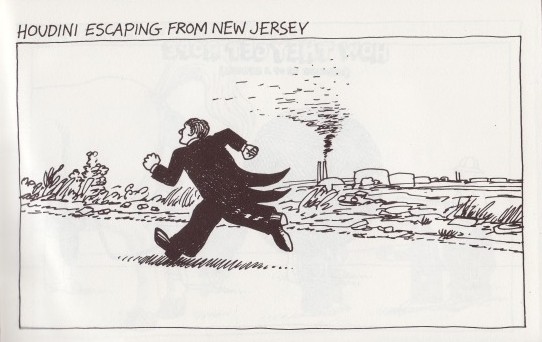
I was able to get in two early-morning runs (under a mile each), the first I've run in New Jersey. While panting along, I found myself giggling at an old B. Kilian cartoon I remembered:


No offense intended toward the Garden State! Put away your pieces.

It turns out that occasional contributor Spartacus has a high-security homestead within a day's drive (and perhaps a few state lines) of the Shrine, so – having already given him ample warning by cell and email – I swung by there as well. At some point this year his patient wife must have prevailed on him to put up a sign warning potential trespassers (and intrepid visitors) of the minefield. I paused a moment with my Sharpie and corrected the Russian spelling (the fresh sign's done up in six languages, IIRC), then pressed the call-button quickly enough to avoid the electric-shock he's wired in.

 "It's switched off!" Sparks yelled through his bullhorn after a moment. It looked like the gate-camera had shorted out during the recent rains up his way, so I figured he didn't know it was me yet. I tossed a couple pinecones over the razor-wire just in case, and turned my back a moment. Sure enough, one of them detonated a small mine. I jumped, and brushed the dirt and pine-needles off my shirt, then quick-pressed the button again.

 "Sorry about that!" came the bullhorned voice… but I could hear a chuckle as he clicked off. "Okay, I've muzzled the dogs!" I sighed and wrapped a beach-towel around my lower arm, and stepped through the gate as it swung open silently. The halogen-spots came on; I should have kept my sunglasses.

Even with that first camera out for now (don't count on it again, though), one still enters the Sparta-house acreage with caution. His motion-sensors all seemed to be active, and I spotted what looked like a shotgun and a blowgun each lift and turn my way as I walked past. No doubt other, less noticeable, devices were marking my passage.) Early on there was another mine-crater and a dog-chewed piece of a salesman's briefcase next to it… but I think that's a prop. Maybe. I stepped over several tripwires to play it safe.

In person, Spartacus is not quite as intimidating, but he's both taller and broader than me – and his wife and oldest child both have black belts in karate (one of his children later showed me her sword, too – nearly as long as I am tall; I am not kidding!), so there was no question how respectful I'd be. He sheathed his bowie knife and shook my left hand, and chided the large dog still clamped on my right arm. The dog dropped reluctantly, its hackles still raised, and we went into the house. I wrapped the now-perforated beach-towel around my neck and dabbed the sweat from my face – it had been much easier going this time than last.

We reminisced a bit; forty years ago we had been schoolkids together… and even then he was taller and broader and older than me, come to think of it. Today I'd brought along some music for his impressive collection, and we checked out some blues-tracks and more obscure good songs that had managed to escape his notice over the years. We also looked over some Simpsons videos I'd included.

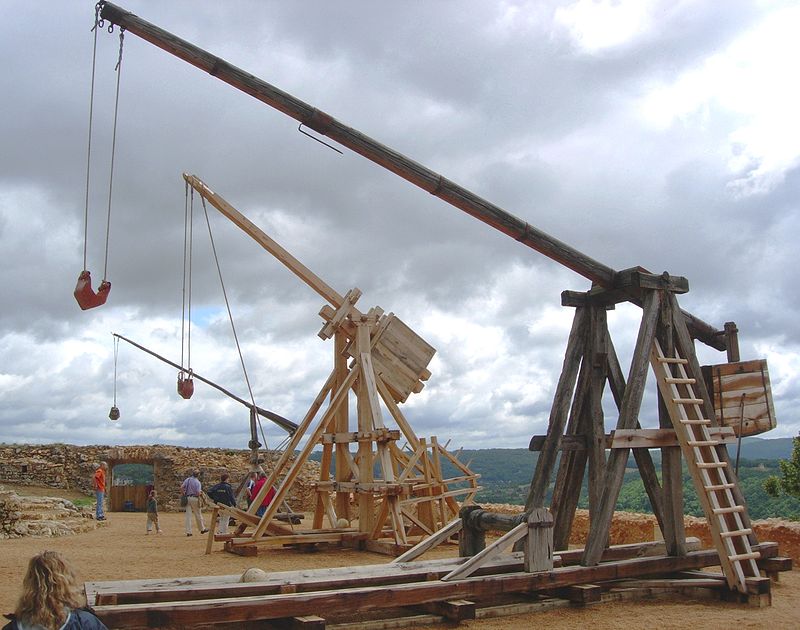
Sparkly took me into his workshops (why have one, when you can have two?), and amid the awesome equipment showed me a beautiful piece of rich, dense, fine-grained, rose-colored wood that he's slowly crafting into a lap-steel guitar. (After His Holiness, my next blog-project here will be to document the progress of this work, including photos and – hopefully – an MP3 of the finished product.) There were several pieces of wooden sculpture he's shaping. And he also has several aircraft-models in progress… which are about as far from the little snap-together kits you and I used to make as… a trebuchet is from a slingshot.

We also talked metaphysics (and I've never met a physics I didn't like), animals – another dog was chewing on my arm at this point, but he's not full-grown (maybe three feet at the shoulder), and was doing his best not to break my skin –, education, family, history, art, exotic cars, toxicology, politics, computers, mustard, and so on. Sparks and the wife and oldest child whipped together (they did not use real whips) a nice steaming bowl of pasta, and a cold bowl of rich salad, plus sauce-sop bread-slices, and I joined the family for a fine, impromptu, casual dinner.

Mrs. Spartacus – fresh back from Switzerland – did me a woman's finest honor and treated me to a modest slab of real, genuine, European black-dark chocolate. It was the best dark chocolate I've ever tasted. In manner she is warm and welcoming… but her fangs and claws are never far below the surface. In this regard – and her growl – she reminds me delightfully of my older daughter. Mrs. and Mr. are an excellent match, and their kids and curs are well raised and respected. And respectful.

Too soon, as always, I had to leave. Sparty flicked on the bank of security-switches as we headed out the reinforced door. I spotted the minefield-lever and switched it back off on the way past. We headed down the sloping trail to my car, and I had the sense to stop right where he did. I stooped and picked up a couple glacier-rounded rocks (Ice-Age glaciers had passed by there a couple-dozen millennia earlier), and threw one a few feet ahead, turning my back once more.

As pine-bark and leaves finished raining down on us, Sparty grinned his infectious best and said again, "Sorry about that." I gestured him ahead of me, and he took the other rock out of my hand and set off one last mine before going any further. Obviously the goodwife had switched them back on immediately; I told you they were a good match!

Once Spark had unclamped the younger dog from my ankle, I cleared the day's debris from my car, gave him a bear-hug, and headed off down the road. After a moment the bright glow of his security-halogens flickered off, and I found myself already missing him and his fortress.

And I wondered suddenly: where does he get the power? I'm guessing they finally hooked in the water-wheel, augmenting their small solar panel, but I wouldn't be surprised if they're also tapped into a vein of off-site, low-level natural radioactives. Possibly their mastiffs take turns on the treadmill, too; I don't know – they're certainly in good shape (and even their semi-feral cat is musclebound). But Sparkle-Cuss would undoubtedly simply shrug and say they've been running the home off political hot air for years.

That can't be true… or their manse would be huge. So you can drive out and ask them yourselves; just don't forget to have some pinecones handy.


Friday, September 21, 2007

Incensed and Enthused


Actually, while temporarily here in the ranks of the unemployed, there are three future-focused endeavors I've been pursuing, though with <guilty blush> varying degrees of active pursuit:
1) Re-employment, but closer to home than my most recent employer;
2) Return to college and get a) associate's degree, b) master's degree, c) etc.; and
3) Find the next steps required toward the priesthood or/and professed-religious life.
This week I must have fired off another dozen résumés, as well as hobnobbed and networked at a bustling job fair. I also paid a courtesy-call on the Provincial House of the religious (women's) order where I'd applied for an open executive-assistant position early last week. The friendly, upbeat receptionist there – incredibly, she remembered me! – checked, and confirmed that only now is the placement-person beginning to review the applications… and she visibly and verbally crossed her fingers for me!
And: where would we Catholic men be without our mothers? My own's been urging me to not neglect Items 2) and 3) above, especially given that many centers of higher education are heavily plugged into their surrounding communities, and have networks of their own in-the-know job-placement folks.
Since I had reason to be in that stretch of Maryland just down the road from Pennsylvania, this afternoon I dropped in on Mount St. Mary's University in tiny Emmitsburg, Maryland (home also of the National Firefighters' Memorial, by the way… and of an ex-girlfriend, come to think of it, one best referred to as Mrs. Robinson, should I mention her here again).
Clueless as to where most of anything is on campus, I popped in at the Student Information Center, and was patiently steered toward the buildings (Admissions, and Seminary) and online resources, where I could take on all three of the above pursuits.
Even before the Admissions building, I had to get to the Seminary, find some kind of office and get some info on the admissions – specifically, to this seminary itself, and in general as a late vocation to various seminaries and avowed religious orders.
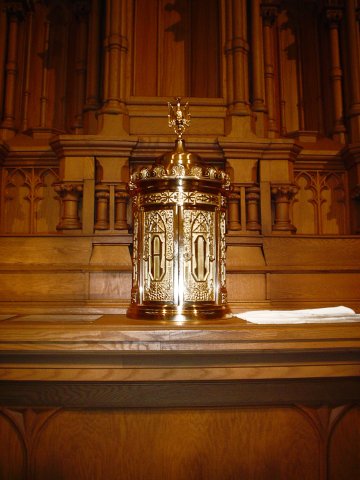
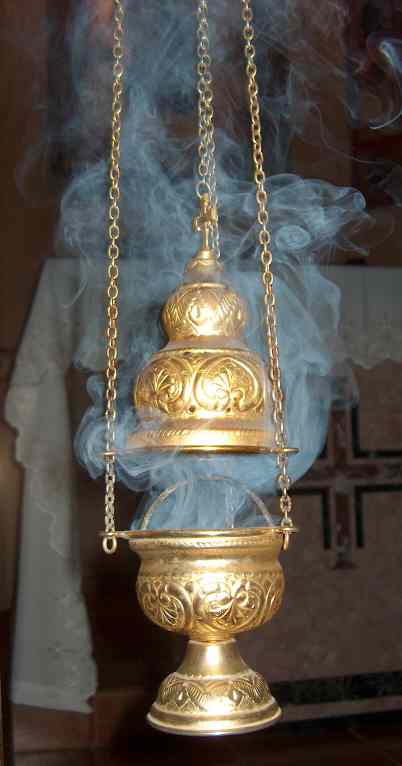
Up the steps – and even before I was through the thick wooden doors, I saw a smoky chapel straight ahead, and my pulse doubled instantly. The smoke, of course, was incense, nearly thick enough to swim through, which I did. A priest was just finishing a Eucharistic exposition/adoration, and I did manage a glimpse of Jesus Himself (yes) as the Blessed Sacrament was removed from the monstrance and put in the tabernacle.
(I'll explain these later for you Protestants… and for many of you Catholics, too; shame on you! For now, all of you go back to John 6:28-68 and read Jesus' words. If we take them literally – and every indication is that this is exactly how Jesus meant them – then the Holy Eucharist is Jesus physically present among us, period. Or he was lying. You wanna call Jesus a liar?)
In attendance there were a dozen or more seminarians – to the untrained eye (including my own), looking like priests in their black-and-whites; among their number as they left was a Franciscan friar I recognized from the Missionaries of the Eternal Word, as seen on EWTN. (Mt. St. Mary's Seminary is their seminary.) As my pulse doubled again, we traded hellos, and he went on down the hall.
I stopped one of the last seminarians leaving, asking him whom I should see, or where I should go, regarding admissions and vocations; he guided me to another seminarian. For a moment I found I had been politely led into the office of the Monsignor himself, His Eminence (I’m not sure if that's the correct mode of address) Steven P. Rohlfs, rector and vice-president.
This was for all of five seconds… which was good, since I would have fainted at seven. His executive assistant ran a gentle, cheerful, and competent interference, and led me into another office or two. She asked patient questions, and gave me the seminary's course catalog, a listing of further resources online (as well as email addresses) specific to my archdiocese, and some further suggestions. As my heartbeat at last approached near-normal (although I was now breaking out in a sweat of mixed enthusiasm, wow, and serious yikes), she also let me know that there'd be a mass at four (it was now a bit after three-thirty) at the Chapel of the Immaculate Conception, on campus.
This was halfway between the Seminary and the University's Administration building… and I never made it as far as Administration; that'll be Monday's trip: once in the Chapel, I remained. I had a little time for prayer and meditation, amid the seminarians there, and further ones joining us seated and kneeling (believe me, I was on my knees).
Then the priests came in, dressed in red robes in honor of the martyrdom of St. Matthew (gospel-writer, Apostle, and entrenched sinner like the rest of us), whose feast day is today. There were eleven priests, probably twice as many altar servers (adult men, not altar boys/girls), and dozens of seminarians filling the old, straight-backed pews. I even got to chant with them in Greek! Incense was once again being wafted about, and I found myself thinking, "Ohhh, I am so out of my league here…"; I absolutely loved it.
As to being out of my league… well, the priest doing the homily – quoting his mother (as well he should) – pointed out that God doesn't call the qualified, He qualifies the called. There's my consolation. I strongly believe I am indeed called into the religious life – by which I mean professed/avowed religious (monk/friar/brother), and not simply living religiously. This is not for any worth on my part or in my nature, but simply because, for whatever reason, there is something (small that it may be) that I can give the Church, and to the world.
Nothing captivates my mind and heart (and pulse) like the faith, and all things Catholica – not a lovely woman, not a box of unsorted nineteenth-century stamps, not even a one-way, first-class ticket to the country of my choice, with language lessons and native-born, English-fluent tutor thrown in at no extra charge.
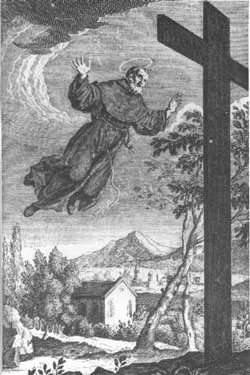
I know this bores some folks to tears, but for me it is just absolutely thrilling. Most amazing today is that I didn't leave the Chapel doing a Cupertino. Well, there's always Monday.
 
Followup: Blue Dog left a warm (and unexpected) comment:
Blue Dog Sep 21, 2007
Wonderful, uplifting post. My prayers are with you and I suspect you will be surprised when you finally learn where God in his wisdom ends up placing you. I know I usually am … surprised that is.

Saturday, September 15, 2007

Pain in the Compass


Okay, Blue Dog's already checked back in: he's not going to give the Political Compass another spin. I'm disappointed a bit, though I suspected (hoping differently) he'd so answer, that he was uninterested in approaching anew that site's series of social-political statements. I was also afraid I might have ruffled that dog's feathers a bit, but that's not the case. Let's put him back on the soapbox – c'mon, boy; up!
Perhaps you misunderstand my answers. I see no second set of answers possible in responding to these questions.
Let us look at [Republican] Ron Paul (not my candidate by the way, just an example). He is utterly opposes abortion. Nevertheless, he also takes the position that as a matter of the United States Constitution, abortion as a matter of law is a non-federal issue left to the states. If you examine Ron Paul's stated positions, I expect that you will find he falls much further toward the libertarian side of the graph than is reflected by his actual placed position among the 2008 Presidential candidates.
Now if you ask me whether abortion, when the woman's life is not threatened, should always be illegal, I say yes. I see no other possible answer given my belief that human life is sacred and that a fetus is a human life. This statement may simplify my position, but after struggling with the issue, I see no other possible response.
(I told Dog in my response to this email that I intend to address this specific issue, and how I as a very liberal, feminist male – yet fully obedient, submissive son of the Church – come down. Likely I'll do so in January… though I may just jump in sooner.)
As another example, your own position places you quite near Gandhi. But ask yourself if someone were to examine your life, would they place you next to Gandhi on the chart. And I do not ask this question in an attempt to question your answers to the questions or the way you live your life.
Dog, my friend, the tool/test does not attempt to graphically place people by overall lifestyle. Rather, it's a look at the person's placement strictly along their social/political/economic outlook. Spiritual-practice-wise, I'd fall more closely to Pope Benedict than to Mahatma-ji. But if we each filled out political ballots (yes, I'd let him go first), I doubt we'd vote in the same slate of candidates.
Now, let us look at your friend Spartacus. He's as socially aware as Gandhi and deep into anarchist territory. I have no problem with his answers. I do not challenge the sincerity of his response. But if the person who put together this test wanted to place him on the chart without first having him take the test, how would this person accomplish that task?
Does Spartacus have a job? Does he pay his taxes? Does he obey most traffic laws? Is he married? Does he support his children? How much does he give away to charities? Has he accumulated any wealth? Does he live the life of an ascetic?
What I am saying is this test judges the world leaders by outside, objective standards. How does Hillary Clinton vote in the Senate? Then it judges us by how we answer the questions on this test.
Of course the big figures in their results-matrix did not take the test themselves, so the authors had to do some conjecture… but are not doing this placement uneducatedly. As they explain on the result-page, "A diverse professional team has assessed the words and actions of internationally known contemporary leaders to give you an idea of how they relate to each other on the political compass." Again, this is political placement, not overall lifestyle; this is political analysis. Oh, well; say on.
Do any of us really live the life of Gandhi? To be honest, I suspect that you may be closer than I to Gandhi. [Gee, thanks, Blue – but you've never seen me in a dhoti.] And I don't know Spartacus well enough to judge. But I know that I have not devoted my life to the poor. I'm your basic businessman who is raising two children, hitting church on Sundays, going to California Coastal Cleanup Day tomorrow with a bunch from my church, working a carwash later in the day for the Church Middle School Group, meeting a young man tomorrow to talk about his future, the kind of mundane, routine things we all do in this life. I give what I can, do what I can, but I definitely do not make the sort of choices in life that would have a neutral third-party put me next to the Dalai Lama or Gandhi after examining my life.
On another note, I suspect most Democratic candidates actually, as they have stated, bitterly oppose to the war. Yet time and again they have voted to fund the war. If a anti-war individual took this test, their answers would reflect their anti-war values. But we would judge Hillary Clinton, etc., on their votes? Or would we judge them on their stated position?
Good point.
What I think is much more interesting is where they place the parties. We see a much deeper spread. For example, the UK Green party cuddles up to Dalai Lama territory. Why? They place the parties on the scale based on their written, articulated positions.
Now, let us examine George W. Bush. With respect to the removal of life support from patients in a persistent vegetative state, his stated position is strongly opposed (and presumably this would track his test answers). But in 1999, he signed Texas legislation permitting doctors to remove life support from such patients regardless of the wishes of the family. Do we go by the stated position of George W. Bush (as we do with our own answers) or do we judge George W. Bush by his actions?
If we look at the historical record, how many figures do we actually find in the Libertarian/Left Quadrant? We find Dalai Llama, Gandhi, (Christ, I suspect, though they do not place him), and Nelson Mandela.
If we asked Nelson Mandela where he stood on economic globalization, I suspect he would favor people over corporations. But when he talks about blood diamonds in the context of that recent film and says, "...it would be deeply regrettable if the making of the film inadvertently obscured the truth, and, as a result, led the world to believe that an appropriate response might be to cease buying mined diamonds from Africa.... We hope that the desire to tell a gripping and important real life historical story will not result in the destabilization of African diamond producing countries, and ultimately their peoples." If we argue that his statement is because lost revenue hurts the diamond mine economy, can we not make that argument in every instance?
In the end, it is an interesting test. But I don't have the same level of faith in it. I need to see if I can find some old threads on it. As I recall, pretty much everyone taking the test ends up at one extreme or another.
No, I didn't end up at any kind of extreme. Given the layout of their matrix, I think "extreme" would be any individual at the far end, left/right or up/down, one of the axes: i.e., not embracing anything beyond a total authoritarian/anarchistic social focus, or/and a total left/right economic focus. These individuals are rare even among demagogs, I'll bet.
The matrix shows that Pope Benedict and I fall differently in terms of authoritarianism – but it's Stalin who's at a far end of the matrix; and overall His Holiness is placed more closely to the middle than I am, in fact; not a surprise to me. And everybody's favorite acephalic chimpanzee, George II, is at an extreme… but at Stalin's opposite? Well, okay; for Uncle Joe the State was supreme, whereas W seems to favor a smaller state… thereby corporations run free, wild, and unhindered.
I responded to Blue Dog, with hopes he and his own people will have at the concept further at his own blog; they a lot more capable and experienced:
Well… I misunderstood your explanation of how you approached the questions/statements. Though your skepticism runs strongly on Political Compass's tool, could you consider maybe dropping it in on one of your own bloggings, and see how your own readers (far more of them than mine, and a good deal less flaky [pardon me there, Spartacus], in all likelihood) fare with the questions, both in how the results paint them, and how they feel about it?
If you take up the topic (and I think it would be a shame if you don't), do please not hold back on expressing your feelings on its accuracy and usefulness, short of preprogramming your keen masses out there in advance of their trying it out themselves.
You're quite free, of course, to quote or reference Empty Tomb in any way you might need – though I doubt it would raise the level of dialog on Blue Dog Thoughts! While I'm muttering to myself in a corner, you're sitting at a long, well-lit table, with organized stations of notepads, water pitchers, and attentive attendees, and dressed in a smart suit and speaking clearly and resonantly. There are no Frisbees.
Likely, as with all tools, this one's not for every mechanic. I can put impressive holes in the drywall with a good drop-forged steel chisel, the next person will carve out a "David", and the next yet will use it to mug a passing grandmother, and yet another lay it on the desk as a paperweight.
Regards,
AgingChild
We'll see how the Compass fares there; ditto, I'll have Mouse's take, when and if. Now, back to Pius.

Friday, September 14, 2007

Spinning the Compass


Spartacus gave me his permission to post/paste up here his comments on the Political Compass website's easy online tool, which has been designed to gauge a person's political locus more accurately than by the inadequate, centuries-old left/right paradigm. While Blue Dog's check-marking a fresh answer-sheet (never any need to erase here!), let's go on with the Compass tool.
I mentioned in the initial blog of this current cascade that I was going to ask charming (and frustrating) conservative-lass Anon E. Mouse to give that tool a shot. I did get a note off to her late yesterday; no response yet, of course, but I'll add her results here as well – and if we hit the jackpot (her husband and their friend F3), they're all getting a place of honor: I really want folks from the traditional "right" to try the tool and join in here.
Actually, since Blue Dog's got the readership (while I've got the sunken ship), it's likelier this will play out much more thoroughly and extensively on his blog, with a nice array of testers from all along the spectrum – er, compass.
The concept of going from a monodimensional spectrum to a bidimensional, arguably more-accurate, graphic placement of individuals politically, will both shake things up and boost the better areas of the transpolitical dialog… if it catches on; I hope it does.
Once I myself had run (or rather, walked) through the statements posed to the users of the Political Compass tool, I let Spartacus know, since – across several state lines – I could hear him shifting from foot to foot, waiting to bring in his perspective on his results, and where they led him. I included for him a screencap of where I placed on the diagram (I’m not as fond of the "compass" word here, myself – more on that in a bit).
Folks, bear in mind the following is one person's own results, and his views and springboardings therefrom; your own mileage will likely vary a good deal. They do give some insight specifically on this particular Empty Tomb reader; they do not give insight to you. End of caveat.
-----Original Message-----
Sent: Wednesday, September 12, 2007 11:09 PM
Yep, had no problem whatever reading the file you attached. Thanks too for attaching your graph, though unfortunately I can't reciprocate--I didn't save mine :-(
I did however, write down my numbers and it should be easy enough to extrapolate where they fit in.
My numbers are -6.63 on the Left/Right axis, and -6.31 on the Authoritarian/Libertarian axis. That lands me comfortably in anarchist territory, and that suits me just fine--I have no faith whatsoever that our present political system is capable of enacting the real change needed to honestly address the ills of this world. Dems/Reps, they're all basically the same, all part of the dog and pony show which helps maintain the illusion of political freedom and keeps people diverted from understanding what is really in their best interest.
 (He and I have batted this viewpoint around before.)
Further reading on the Political Compass site steered me toward looking into anarcho-syndicalism (a dimly forgotten term from a half remembered college poli-sci course). I've since Googled and surfed a number of anarcho-syndicalist sites--yes, it's a philosophy I can really get behind (I'm sewing up a red/black diagonal anarcho-syndicalist flag even as I type--LOL!).
Here are links to some of the sites if you're interested:
I too was relieved to find myself in Gandhi's and the Dalai Lama's neighborhood--some of those other neighborhoods are SCARY, not the sort of places you want to be in after dark!
Taking the Political Compass quiz has also helped trigger thoughts about how my political philosophy has developed over time. I used to characterize myself as a Libertarian, but then grew gradually more uncomfortable as I began to realize the right wing implications of Libertarianism (at least as it is perceived in the USA--elsewhere it apparently has a more leftward tilt), so it was really quite interesting to see by my numbers how the strong libertarian feeling is tempered by an equally strong left orientation.
When I was in college and grad school in my 20's, I had a strong aversion to the leftist bias of my professors. Even though I lapped up courses such as history of socialism, (and indeed, my virtual, unofficial "minor" was utopian socialist philosophers and communes of the 19th century), I suspect that strong libertarian streak clouded my judgment about what was really being said. I just couldn't differentiate between the liberal socialism (anarchism) I find so instinctively appealing, and the sad authoritarian "socialism" of the Bolsheviks, Communists, et al. Then again, I'm also going to lay some of the blame at my professors' feet--in retrospect they really didn't do such a good job of making those differences clear (probably the effect of years of student apathy if not outright hostility--the '80s were light-years from the '60s!!).
Mentioning utopian socialist communes above also brought to mind something else I've been interested in for a long time--monasticism (for it's social, not religious, aspects). I think I told you before how I asked my medieval history professor into lending me the key to the library's rare books room so I could pore over "The Plan of St. Gall", an oversized tome describing an ideal monastic community of the Carolingian age (IIRC). Communal living fascinates me. IMHO, it is the natural way for humans to live, and one of the reasons for humanity's ills is that we live apart--there is too much emphasis on the myth of individualism. Human beings were never historically expected to cope on their lonesome as they do today--only recently have we lost that real and vital aspect of true community. Though only the most paranoid would say it's been deliberate (I am tempted though!), isn't it interesting how our present political system has benefitted from keeping people socially isolated--divide and conquer!!!
Junior Proudhon
A particular term there rang a bell in my memory-banks as clear as a call to one of Pavlov's dogs:
-----Original Message-----
Sent: Thursday, September 13, 2007 2:45 PM
Subject: RE: Bloody Peasant!
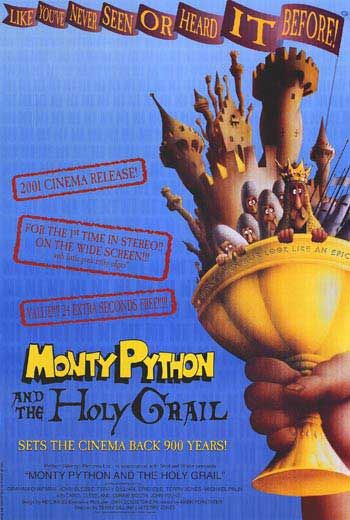
Thank you for the anarcho-syndicalist information; it's interesting enough that I definitely want to dig into that some more myself. But I almost choked on my lunch at your mention of the term. I've been familiar with it since the mid-seventies, owing to a scene from "Monty Python and the Holy Grail":
Take a moment and watch that, and enjoy. Essentially, you are the peasant Dennis here (the actor is Michael Palin – you may recall him as the stuttering fellow in "A Fish Called Wanda"); here King Arthur and his groom Patsy are seeking regional lords (they're riding their coconut mock-horses… never mind) to aid in his quest to find the Holy Grail.
My brothers actually aimed me at the move in my teen years, and shoved hard; so I'll bounce the links – likely today's blog, too – back at them for further reaction.
I agree with you on the odd turns organized libertarianism has made here in the US – certain of the concepts are great (even Patrick Henry would approve some of 'em, methinks), but I just look over Larouche and … <shudder>.
I'm actually not as much in step with you on the social concept of monasticism/communalism. (Though for me my personal move into that realm would be part of a spiritual progression, of course.) My own feel is that there are enough self-focused people among the general rabble who simply aren't constituted for that kind of community: either they'd lash out, or plunder, or seize control. I.e., "more equal than others". Some are already in such communities, too… which makes it all that more exciting. <yawns and grits teeth simultaneously>
More thought required here, of course!
That video seems to have gotten Sparklers chuckling while pulling up the drawbridge and dropping more gators in the moat:
-----Original Message-----
Sent: Friday, September 14, 2007 4:59 PM
I got a private chuckle from the YouTube link you sent--not just for the humor involved, but also because when I Googled "anarcho-syndicalism", one of the "hits" I received was to a transcription of that very same "Holy Grail" scene. Little did those guys realize that years after the movie, websurfers seeking info on certain liberal-socialist philosophies would be sucked into the Python demiverse.
>"I'm also going to pass that site's link to Mouse and ask her to answer the questions and let me know how the testing scores her (again, no rights or wrongs – or lefts – there) and add the info (with discretion and permission), as well as Blue Dog's if we can get him to scratch our itch on it. I'm also hoping Mouse will get her husband and some of their cronies to give it a shot, and get back with me… might contact at least one of them directly myself."
I think that's a great idea--be sure to stress when you're making the pitch that it is a non-partisan quiz, that it is just a tool.
> "I'm actually not as much in step with you on the social concept of monasticism/communalism...My own feel is that there are enough self-focused people among the general rabble who simply aren't constituted for that kind of community..."
Well, I certainly wasn't suggesting something like that be compulsory! I was thinking more in terms of the "village" in the "old country", where people lived together in extended families, and, more often than not, also worked together toward common goals. My grandfather used to tell stories about how it was growing up in a village in Sicily--pretty much everyone was related to everyone else in one way or another, and they would work the fields together as a village. During harvest time the men would work in the fields while the women were back in the village cooking the midday meal, which they would then bring out to the men and everyone would eat together and then take a siesta during the heat of the day--they shared the labor, they shared the responsibilities, they shared the fruit of their labors. No woman was left alone during the day to take care of her baby all by herself--there was an extended network of aunts uncles cousins, bros, sisters, etc to help. If someone got sick, injured, died, it wasn't a dire bow to the family's well being, because the family didn't exist in a virtual vacuum as do so many families today.
Personally, I am someone who appreciates his privacy, but I have to admit, living here in relative isolation, that I wouldn't mind being in a community of like minded people working toward some common goal. I suppose that's one reason I have so much respect/admiration for the Amish.
I think life amid the Amish would indeed be a paradise of sorts for ol' Spartacus, someday. I could pop in occasionally in robe and tonsure and coach him through his archaic German, and maybe also sneak in a bit of Latin and Old Church Slavonic while he's not looking, just to confuse things a bit. Piēs Jēsu Dōmīnē…
He does have a point there, on a social concept of humanity reworked as (or reverted to) a network of small communities of extended families, communal-like villages. We could do well to lose the iPods and drive-by shootings… but if we're also going to be capable still of transcontinental flight, some kind of Internet, and cutting-edge medicine – let alone adequate distribution of food and resources to the world's masses – then we can't toss out the infrastructure. We'll still need power, transportation… brother.
Ah; another, later topic – not to mention taking a longer look at the whole realm of a spiritual monastic community. Let's get back with the Political Compass for now, though. I'm hoping Blue can try the tool again, likewise a range of his readers, and also Ms. Mouse. If they don't have a chance to come by and visit in the next couple days, I'll get back on redeeming His Holiness.
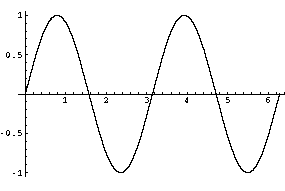
But the reason I said, above, that I'm wary of using the term "compass" to describe placement of a point on an x/y graph is that "compass" embraces the idea of a direction-finder, and movement. Yet each person's placement on that grid is static – no tangents, or trés-cool sinusoidal waves, even, let alone an arrow locking on the magnetic north/south. I don’t think the tool functions as a "compass" at all, other than to suggest "You Are Here" in your political outlook, and that these people of particular impact through sociopolitical history are your neighbors.
Just unimportant semantic fussiness on my part; Blue Dog and Bark-a-Cuss are the big political hounds around here, and know a good deal more about these things than this mere Aging Child does. As do, especially, the developers of that Political Compass in the first place!
Good night for now.